



Teaching your child to brush their teeth is usually one of the first oral hygiene habits parents focus on. But what about flossing?
Brushing cleans the surfaces of the teeth, but a toothbrush may not effectively clean the tight spaces between teeth. Once your child’s teeth begin touching each other, flossing can help remove plaque and food from these areas and support healthy teeth and gums.
The key is to introduce flossing gradually and make it part of your child’s everyday routine. Here’s how you can approach it at different ages.
When Should Children Start Flossing?
There isn’t one specific age when every child needs to start flossing. A useful time to begin is when two teeth are close enough together that a toothbrush cannot properly clean between them.
For some children, this may happen during the early years as more baby teeth appear.
At first, parents will need to do the flossing. As children develop better coordination, they can gradually learn to take over with your supervision.
Ages 2–4: Parents Take the Lead

At this age, your child is unlikely to have the coordination needed to floss independently. If their teeth are touching, you can gently floss between them.
Keep the experience short and relaxed.
A few tips can help:
- Choose a time when your child is calm.
- Use gentle movements between the teeth.
- Avoid snapping the floss into the gums.
- Explain what you’re doing using simple words.
- Praise your child for cooperating.
You can say something as simple as, “We’re cleaning the tiny spaces your toothbrush can’t reach.”
Making flossing feel like a normal part of brushing can help your child become comfortable with it.
Ages 5–7: Let Them Start Practising
Children at this age often want to do things themselves. This is a good opportunity to let them practise flossing while you continue to help.
Traditional floss can be difficult for small hands, so child-friendly floss picks may sometimes be easier to hold and control.
Teach your child to:
- Gently place the floss between two teeth.
- Move it carefully against the side of one tooth.
- Clean slightly below the gumline without forcing the floss.
- Repeat against the neighbouring tooth.
- Move on to the next space.
Your child may want to do the entire routine alone, but it’s still a good idea for a parent to check and help with areas they have missed.
Ages 8–10: Build Independence
By this age, many children are developing better hand coordination and can take more responsibility for their oral hygiene.
Encourage your child to floss independently, but continue checking their technique.
Remind them to:
- Floss between teeth that touch
- Move the floss gently rather than forcing it
- Clean both sides of the space between the teeth
- Take their time instead of rushing
- Floss consistently as part of their daily oral care
A mirror can make learning easier because your child can see exactly where the floss is going.
Ages 11 and Up: Make It Their Own Routine
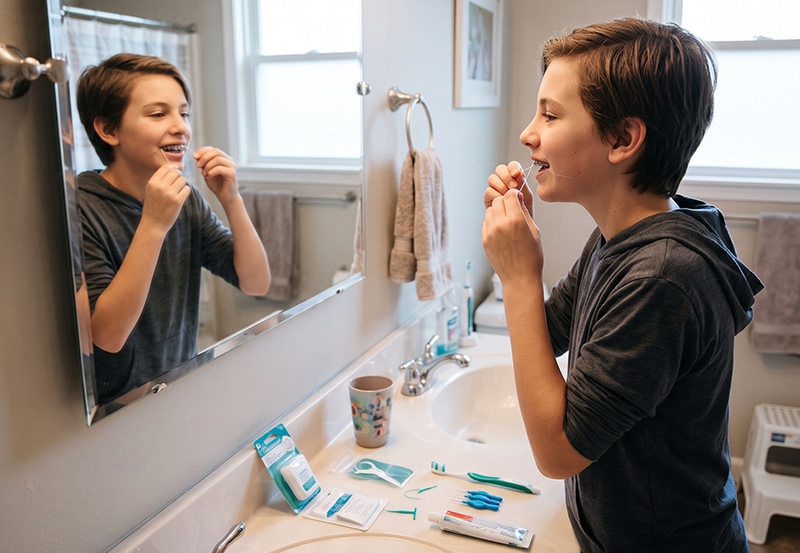
Older children and teenagers should gradually become responsible for their own brushing and flossing habits.
At this stage, the challenge is often less about learning how to floss and more about remembering to actually do it.
Help make flossing convenient by keeping the appropriate cleaning tools somewhere easy to see and reach.
If your child wears braces, their dentist or orthodontist may recommend additional tools such as:
- Floss threaders
- Orthodontic floss
- Interdental brushes
- Other cleaning aids appropriate for their braces
The dental team can demonstrate how to clean safely around brackets and wires.
How to Make Flossing Easier for Children
Flossing doesn’t need to feel like a daily battle. Keeping the routine simple and positive can make children more willing to participate.
Try these ideas:
- Floss together: Children often copy what they see their parents doing.
- Keep it consistent: Add flossing to the same part of the daily routine.
- Let them choose: Allow older children to choose an age-appropriate flossing product they like.
- Use encouragement: Focus on building the habit rather than expecting perfect technique immediately.
- Keep it positive: Avoid turning flossing into a punishment or argument.
The goal is to help your child understand that cleaning between their teeth is simply another normal part of looking after their smile.
What If Your Child’s Gums Bleed?
You may occasionally notice some bleeding when your child first starts flossing, particularly if plaque has accumulated around the gums.
Continue cleaning gently rather than aggressively.
If the bleeding continues, happens frequently, or your child has swollen, painful or unusually red gums, arrange a dental check-up. Your dentist can check their gum health and make sure their brushing and flossing technique is appropriate.
Should Children Use Floss Picks?
Floss picks can be easier for some children to handle than traditional string floss, particularly while they are learning.
However, the most suitable option depends on your child’s age, the spacing between their teeth and their ability to use the product correctly.
If you’re unsure, ask your child’s dentist to recommend an appropriate option and demonstrate the correct technique.
Healthy Habits Start Early
Teaching your child to floss is about more than keeping food from between their teeth. It’s about developing an oral hygiene habit they can carry into adulthood.
Start slowly, keep the experience positive and give your child more independence as their skills improve.
If you’re unsure when your child should start flossing or how to teach them the correct technique, contact us today at 800777000 to book a consultation with our specialist pediatric dentist at Go Dental Clinic. Our team can assess your child’s teeth and show both you and your child simple ways to keep their teeth and gums clean and healthy.